Uganda Pipeline Project Splits Families and Strips Communities of Land, Graves and Livelihoods
As the East African Crude Oil Pipeline advances, residents in western Uganda describe lost ancestral land, broken families, environmental damage and compensation they say fell far short.
By Juan Gonzalez · · Originally reported by KJZZ
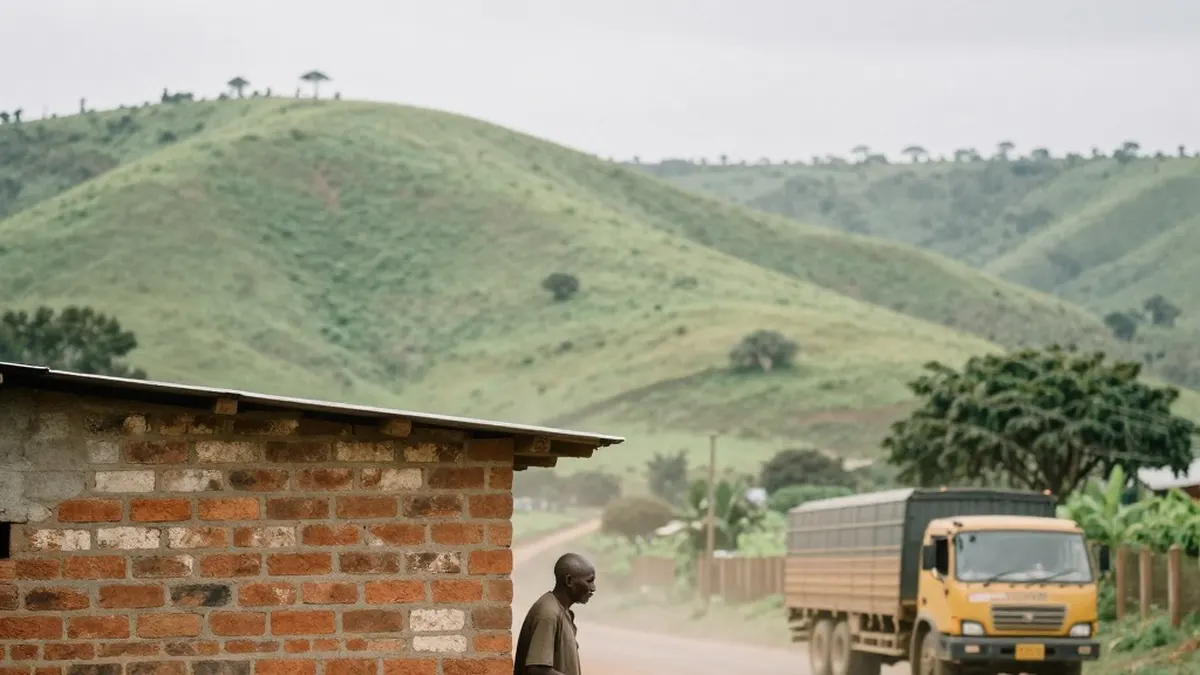
In the green hills of western Uganda, 88-year-old Ukura Midar sits outside his new brick house, looking toward land he can no longer reach. His family lived, farmed and buried their dead there for more than 50 years. "Here, I feel bad," he says. "There I felt very fine. I had my land."
Midar was forced out in 2017 to make way for an airport meant to serve Uganda's growing oil industry. The government moved him and nearly all of his community to a settlement called Kyakaboga, 15 miles away. The graves of several relatives, including three of his children, now lie behind a fence guarded by the Ugandan military. He says that separation makes him ill, because in his belief the spirits of the dead can make the living sick.
His case is one of thousands linked to the East African Crude Oil Pipeline (EACOP), a project led by French energy company Total with Chinese partners. The nearly 900-mile line will carry crude from the Lake Albert region of Uganda to the port of Tanga in Tanzania, on the Indian Ocean. Supporters say oil exports could transform Uganda's economy, but the project is expected to displace roughly 100,000 people. Juliette Renaud of Friends of the Earth says large energy projects around the world have taken community land while also violating cultural rights and identity.
Diana Nabiruma of the Uganda-based Africa Institute for Energy Governance says the pipeline route has in some cases split families, with parts of a homestead ending up on opposite sides of it. Compensation payments have caused rifts too. "Greed arises, unfortunately," she says, and some relatives have turned on one another. She adds that the arrival of oil workers with comparatively high salaries has also affected family structures.
Jacklin, a 38-year-old mother of nine children aged 2 to 21, says the payout contributed to the end of her marriage. NPR withheld her full name because naming her could endanger her. She says her husband took up with new wives after receiving his share of the money and now has three. She is left to support the children alone, and none of them attend school. Her $2,700 in compensation went toward a new house that remains unfinished. She still farms her old plot in secret, knowing the crops that sustain her will be lost once construction reaches it.
Environmental and health problems have followed as well. Bassima Joram, 60, owns several acres of crops, goats and fruit trees beside a new road linking the airport to oil pads near Lake Albert. He says vibrations from constant traffic leave him stressed and unable to sleep. Contractors dumped displaced soil into nearby water sources, silting them up and forcing residents to walk farther for fresh water. A grievance committee he helped set up wrote to the Chinese contractors, the district government, the district environmental officer and Uganda's National Roads Authority, and received no answers.
Joram, who received more than $30,000 for his land, far more than many neighbors, says the process allowed no bargaining. "There was no negotiation at all," he says. He argues the money could not replace the long-term income and family wealth the land provided.
The contractors, part of China National Offshore Oil Corporation, did not respond to requests for comment. Uganda's energy ministry said its record showed "full transparency and accountability" and that companies must meet conditions set by the national environment authority, enforced through audits, water quality monitoring and community feedback systems. EACOP said it has shown a strong commitment to fair restitution in line with national law and international best practices, offered financial literacy training, and that the vast majority of affected people received full replacement value for their assets.
Oil production is expected to begin in the coming years. Meanwhile, Midar still sits on his stoop, unable to cross the fence to his children's graves, and Jacklin farms on borrowed time. Joram wakes each day to trucks carrying workers and equipment to the oil fields.